
By: John Hsieh
Published: Oct 6th, 2025
Zone 2 training is low-intensity cardio that strengthens your heart, boosts endurance, and supports long-term health. By training at a steady, sustainable pace, you improve energy, metabolism, and resilience for the years ahead

Most people think exercise has to be intense to count, but that isn’t true. Zone 2 training is a simple, steady kind of cardio that can improve your energy, heart health, and long-term fitness. In this article, we’ll explain what Zone 2 is, why it matters, and how to get started.
Exercise intensity is commonly grouped into training zones, which help us understand how hard our body is working and what physiological systems are being challenged. A typical 5-zone model (based on heart rate or effort) includes:
We use zones because each one produces different adaptations. Zone 2 is special: it’s intense enough to train your cardiovascular and metabolic systems, yet gentle enough to maintain for longer periods and avoid overtraining.
Your body has two main fuel sources: carbohydrates (glucose in the blood and glycogen stored in muscles and liver) and fat. Carbs are quick and easy to use, which is why your body grabs them first when exercise begins. Fat is slower because it can only be processed in mitochondria using oxygen, while carbs can be used both with and without oxygen. However, fat is also your largest and most sustainable energy reserve.
This balance between carb and fat use shifts as exercise intensity changes. At very easy paces, most of your energy comes from fat. As you push harder, your body leans more on carbohydrates. Zone 2 is where fat oxidation reaches its peak before carbohydrates fully dominate.
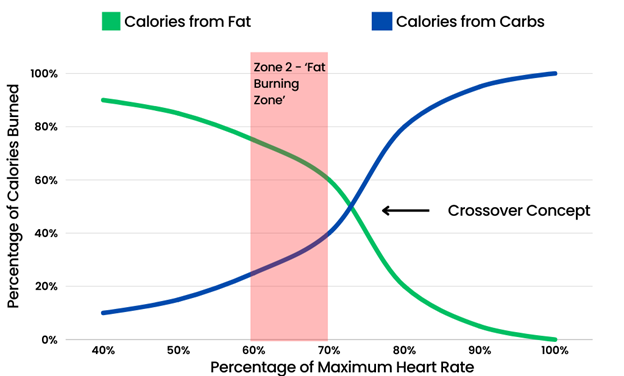
This chart shows how your body shifts between fat (green) and carbohydrates (blue) as exercise intensity increases. Zone 2 is highlighted as the range where fat oxidation peaks before carbs fully take over.
Zone 2 training doesn’t just change which fuel you burn; it upgrades your body’s entire energy system:
Because of these physiological changes, Zone 2 training has wide-ranging effects on health, performance, and longevity. Research has shown it can improve cardiovascular efficiency, metabolic health, endurance, and even resilience against chronic disease.
You don’t need a lab test or expensive gadgets to know if you’re training in Zone 2. There are a couple of simple ways to check:
Some athletes use lactate meters for precision, since Zone 2 sits just below the point where lactate starts building up in the blood. But let’s be real, finger-prick tests aren’t practical for most people, and nobody wants to carry a lab kit on a jog (Not to mention the cost runs into the $100s).
The bottom line: if you can keep moving for 30–45 minutes, carry on a conversation, and feel like you’re working but not suffering, you’re almost certainly in Zone 2.
Zone 2 training is not about speed or power. It is about settling into a steady effort you can hold for a long time. Many people think of it as long slow cardio, but the key is consistency at the right intensity.
The most common and effective ways to get into Zone 2 are:
How much is enough? Aim for 30 to 45 minutes per session, three to four times per week. This adds up to the 150 minutes of moderate activity per week recommended by the American Heart Association. Beginners can start smaller, with 10 to 15 minutes at a time, and build up gradually.
Zone 2 should never feel like punishment. If you are gasping for air, you are too high. If you feel like you could go all day, you are in the right place.
Zone 2 is simple in theory, but it is easy to get it wrong. Here are the most common mistakes and how to fix them.
Going too hard – Most people drift into Zone 3 or 4 without realizing it. This misses the point of Zone 2, where fat burning and endurance are maximized.
Fix: Slow down until you can talk in full sentences, even if it feels easier than you expect. If you are having trouble, use a heart rate monitor device or a treadmill with a heart rate monitor.
Cutting workouts too short – Ten minutes is better than nothing, but Zone 2 adaptations require longer sustained effort.
Fix: Aim for 30 to 45 minutes when you can and build up gradually from shorter sessions.
Expecting quick results – Zone 2 improves health and endurance over months, not days. Many give up because they do not see immediate changes.
Fix: Track your consistency instead of short-term results. The benefits compound over time.
Zone 2 is not the only type of exercise you need, but it is the foundation. High intensity workouts, strength training, and flexibility work all play a role in overall health. The difference is that Zone 2 builds the aerobic base that makes those other workouts more effective and more sustainable.
Think of it like this:
When you put them together, you get a balanced program. Without the base of Zone 2, though, the rest has nothing to stand on.
Zone 2 is not flashy, but it is powerful. By spending time in this moderate training zone, you:
The beauty of Zone 2 is its simplicity. You do not need expensive equipment or elite fitness to get started. Walking, running, cycling, or swimming at a steady pace can all put you in the zone. Stay consistent, and the benefits add up not just for performance, but for long-term health and longevity.
With DPC now officially compatible with HSAs, there’s never been a better time to take control of your healthcare.
Join SALTA today or schedule a free consultation to see how Direct Primary Care can work for you.
John Hsieh is the Director of Growth at SALTA Direct Primary Care and the Michigan Chapter Lead for the Free Market Medical Association (FMMA). With a background in biomedical engineering and business, he is passionate about transforming healthcare through patient-centered models like DPC and works closely with employers, brokers, and clinicians to drive cost-effective, high-quality care.
Healthcare decisions can be complex. Our team is ready to answer your questions and help guide you in the right direction.